Rail to the future


Save the Date

CoMotion LA ‘26 is back November 18-19 for a very special 10th edition: Cities on the Move: Mega-events, AI & Shaping What’s Next — featuring the OMF Summit Track.
As Tesla gingerly expands its robotaxi network into a new U.S. city, there is also a fair bit of exciting news on more traditional modes of transportation. High fuel costs have prompted a surge in demand for carpooling, prompting France’s Blablacar service to expand into 20 new countries. And while America can’t figure out how to build rail, the two other World Cup host nations are showing some promise on that front — Canada is planning a 1,000 km network connecting all of its major eastern cities and Mexico is aiming to triple that. Plus, Britain’s likely next leader believes he learned some important lessons in Manchester about how to revive British public transport.
What you need to know

Tesla expands robotaxi service to Miami: Tesla Robotaxi begins offering rides in a small part of Miami. While Tesla stock briefly rose in response to the news, the gains quickly faded as investors recognized that the latest announcement was not yet evidence of the widescale deployment upon which Tesla’s massive valuation is premised. Tesla’s fleet in Texas, where it launched its Robotaxi service last year, still consists of only a few dozen vehicles. Elon Musk has dialed back expectations, saying that the company will not try to significantly scale up operations until next year.
…and hits record sales: In another bit of news that is good but somehow also disappointing, Tesla posts its biggest Q2 figures ever, delivering more than 480,000 vehicles. However, it was still outpaced by China’s BYD, which retook its place as the world’s top-selling EV brand with 557,000 deliveries. Before Tesla shifted to robotaxis and robots, its tremendous valuation was based on an idea of it becoming a quasi EV monopoly. Those days are long gone.
The carpool gets cooler: French carpool platform Blablacar announces a major expansion into 20 new countries (to 41 in total). The company has observed a surge in demand for shared rides in response to high fuel costs. Its expansion includes eight new markets in Latin America, five in Asia, six in Europe and Morocco, its first African market
As if sunbelt transit needed more problems: Bus drivers and other employees of Austin’s Cap Metro authorize a strike in an effort to get French transit contractor Keolis, which oversees the agency’s operations, to improve its wage offer. The drivers also complain that the company is not providing new drivers enough training. A strike by public employees in Texas is exceedingly rare. It would be an inopportune time for a major disruption to Austin’s transit system, which was recently forced to dramatically scale back and delay a promised light rail system due to cost increases.
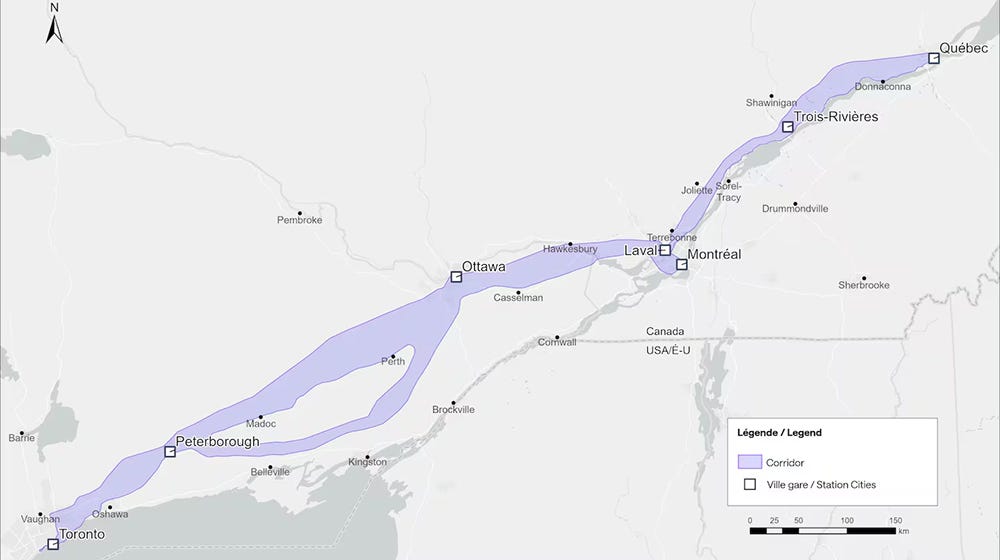
A promising rail system in Canada: Canada’s rail system has planned a 1,000 km high-speed route connecting the country’s major cities in the east, including Toronto, Ottawa, Montreal, and Quebec City. While small cities clamor to get added to the line, many in rural Canada don’t want a rail line anywhere near them. Whatever they do, let’s hope it takes them at least a couple decades less than California.
…and Mexico: President Claudia Sheinbaum wants to make Mexican rail great again. She is pushing plans to build 3,000 km of new passenger rail service, reviving a mode of transport that has deteriorated over the past half-century. Among the reasons that analysts are optimistic that the dream will be realized: much of the new passenger network is being built alongside existing freight routes, where the right-of-way is already secure.
What we’re reading
A transit prime minister: The Guardian looks at likely incoming UK Prime Minister Andy Burnham’s role in overhauling Greater Manchester’s transit system, streamlining a bunch of competing and siloed agencies into one coherent, integrated network. Burnham is a fierce critic of past privatization efforts and believes that Manchester can serve as a model for reviving British public transit.