Do Waymos Take the Day off During Power Outages?


ICYMI: CoMotion GLOBAL 2025 concluded in Riyadh on Dec. 7-9 and brought together global decisionmakers, industry leaders, city executives, innovators, and investors to chart the future of mobility in Saudi Arabia and worldwide. Check out the nice photos over on our Flickr page.
Another week, another self-driving controversy. A power outage in San Francisco brings Waymo’s entire autonomous ride-hailing fleet to an unexplained halt, while California regulators rule that Tesla misled consumers on its self-driving capabilities.
Also: what metal will define the EV future? The economies of several countries depend on the answer. EVs are notorious for fires, though they’re actually dramatically less prone to fires than good old fashioned internal combustion engines. Meanwhile, Wisk Aero is inching forward on autonomous passenger flights, an MIT study shows why Mexican buildings are particularly good at capturing carbon, and for the first time in a long time, a major American city is focusing on buses.
Happy Holidays! We’ll see you in 2026.
ICYMI
CoMotion GLOBAL 2025 in Riyadh: We were delighted to witness major announcements at our event, including:
- Archer Aviation signing an MOU with the General Authority of Civil Aviation to deploy electric air taxis across the kingdom.
- inDrive signing an MOU with Ai Driver to begin autonomous ride-hailing services in Saudi Arabia.
- The unveiling of a new study by MIT Mobility Initiative and the Kearney Advanced Mobility Initiative: Envisioning the Future of Mobility Powered by AI, which calls for unprecedented public–private collaboration, shared data ecosystems, and integrated national strategies to fully unlock AI’s mobility potential.
Plus, Zagdaily reports on key discussion at the event: How AI, real-time routing, and autonomous vehicles are shaping Demand Responsive Transit.
What you need to know
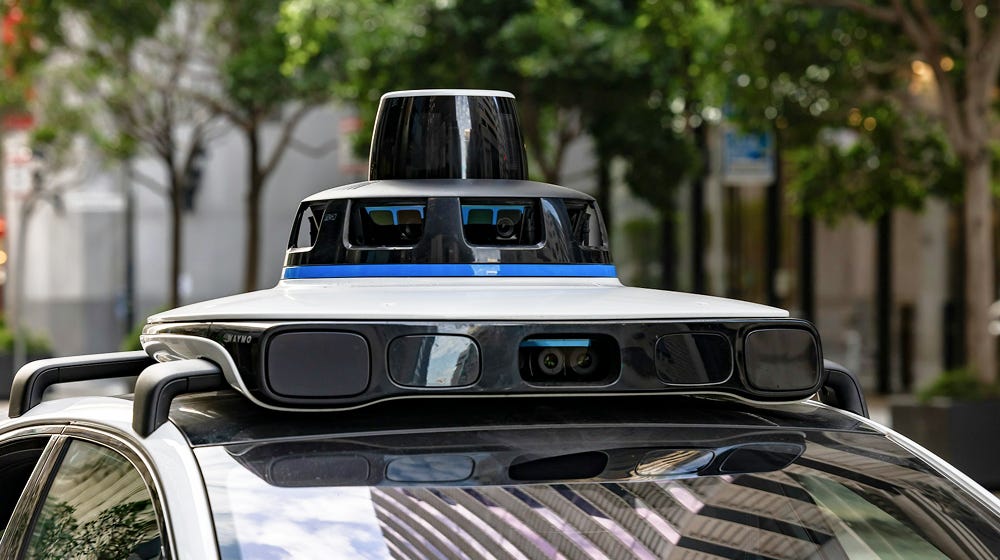
Power outage leaves Waymos stranded, and nobody knows why: A major power outage in San Francisco knocks out traffic signals and leaves Waymo’s autonomous vehicles stalled or stranded at intersections, prompting the company to temporarily suspend its robotaxi service as drivers and riders were caught in traffic chaos. Nobody appears to have been injured, but it raised some eyebrows: driverless cars are not supposed to “rely on an immediate communications link,” as one expert put it.
Tesla’s non-autonomous robotaxi fleet: While Elon Musk taunted Waymo over its power outage shutdown, it’s worth remembering that his own company is still not operating fully autonomous ride-hailing anywhere. Nevertheless, Tesla has registered over 1,600 vehicles and 798 drivers for its Bay Area ride-hailing service with the California Public Utilities Commission, up from 28 vehicles and 128 drivers when the service launched in August. It’s not clear how many of those cars are actually in use, however. It should be noted: Tesla is not authorized to operate autonomous ride-hail yet, and California’s Department of Motor Vehicles just ruled that Tesla misled consumers by marketing its “Autopilot” and “Full Self-Driving” features as more capable than they actually are.
Turns out gas is flammable: EV fires are hard to put out, but the data are clear: EVs are far less likely to catch fire than gas or diesel-powered cars. In the U.S., there are 25 fires for every 100,000 EVs sold, compared to 1,500 for combustion engine vehicles.
Which metal will win out? Reuters metal columnist Andy Home describes how rapid changes in EV battery technology may spell doom for certain metals and the countries that have invested heavily in mining them. The rise of lithium-iron-phosphate (LFP) batteries is bad news for Indonesia, the world’s largest source of nickel, and the Democratic Republic of Congo, the largest source of cobalt. Lithium is king for now, but its reign could be threatened by the development of sodium ion batteries.
A big step up for eVTOLs: Wisk Aero completes its first flight of a fully autonomous, passenger-carrying air taxi. Wisk, a Boeing subsidiary, claims that its four-seat Generation 6 eVTOL is the first such aircraft to be a candidate for FAA certification. Unlike the air taxis being tested by the likes of Joby and Archer, Wisk’s new aircraft has an “autonomy-first” design, lacking pedals and other human controls.
The hidden environmental power of cement: A new MIT study finds that ordinary cement in buildings and infrastructure naturally “breathes in” and locks away millions of tons of carbon dioxide over time, with U.S. structures sequestering about 6.5 million metric tons annually—around 13 % of the industry’s process emissions. The research uses modeled archetypes to show how concrete’s chemistry and structure cause CO₂ to become stable calcium carbonate, suggesting better accounting and design could enhance this hidden carbon sink. For instance, the study finds that buildings in Mexico tend to sequester a greater share of cement sector emissions because builders there tend to use more porous materials like mortar and lower-strength concrete.
Sensible e-bike regulation or “victim blaming”? The New Jersey Legislature appears poised to pass legislation requiring owners of any type of e-bike (including those capped at 15 mph) to obtain licenses, insurance and registration. Legislators point to recent deaths in which e-bike users were killed by cars as evidence that the new technology requires greater restrictions. Active transportation advocates say the bill pins the blame on the wrong technology and will simply result in fewer people taking advantage of an alternative to cars.
What we’re reading
All hail the humble bus: In Bloomberg CityLab, Aaron Gordon applauds the attention that Zohran Mamdani’s campaign has given New York City’s unappreciated but vital bus system. The big challenge the incoming mayor faces is not making the buses free, but making them fast. By the way - Nik Hunder has a plan to do that in Chicago.