Is the World Cup a good deal for cities?


Save the Date

CoMotion LA ‘26 is back November 18-19 for a very special 10th edition: Cities on the Move: Mega-events, AI & Shaping What’s Next — featuring the OMF Summit Track.
If your city is offered a chance to host a World Cup match, you can’t possibly say no, right? And yet, when you crunch the numbers, the economic picture doesn’t look so good. But should cities only be thinking of their bottom line when making these decisions? Or should they think more like the millions of fans trekking across the globe to splurge on a once-in-a-life experience?
What you need to know
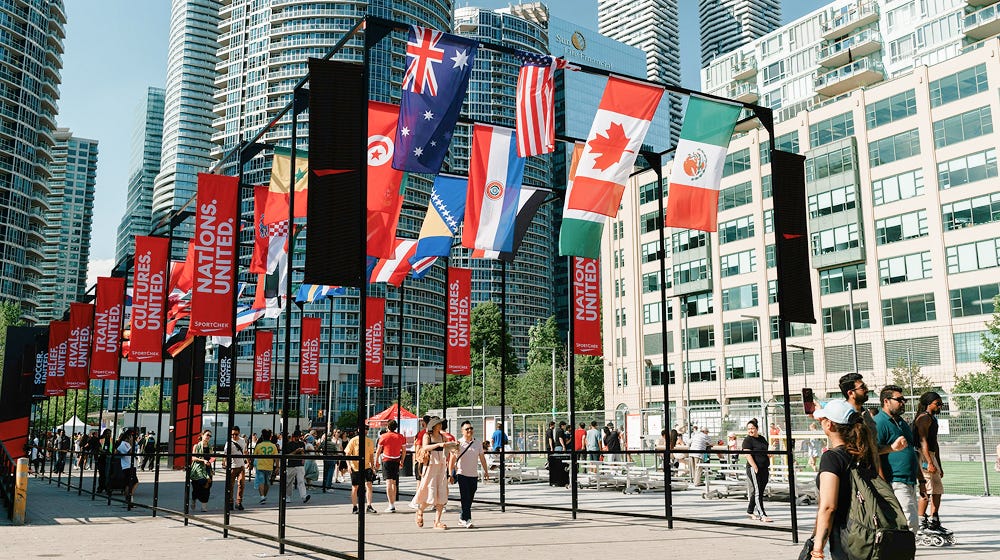
International flags adorn an urban plaza in Toronto - Photo by Frank H
The World Cup’s underwhelming economic impact: An analysis published by the Parliamentary Budget Office of Canada finds that the costs of hosting the World Cup far exceeded the benefits — at least in a strictly economic sense. Credit card spending at bars and restaurants in Toronto, which hosted six matches, were only 3% higher than during the same period last year. Meanwhile, Toronto taxpayers paid about $380 million for the event. Former Toronto Mayor David Miller, for one, believes FIFA are “sharks” who pass on as much of the cost of the tournament to local governments but still reckons the matches are worth it for the excitement and kinship the event fosters.
Historically the World Cup was run by local organizing committees (tied to a national soccer federation) that were responsible for the costs but shared the revenue with the host cities. Now FIFA has centralized control of the event. Under the new model, the cities are bearing much of the cost but not getting a cut of the revenue.
The economic impact of professional sports in general and major sporting events in particular is a perennial debate in cities around the world. There is a broad academic consensus that subsidizing professional sports stadiums is bad economic policy but few city leaders can resist doing it anyway, especially when the beloved local team threatens to leave.
Major events like the World Cup and Olympics have also prompted fierce debate about economic tradeoffs. Even soccer-obsessed Brazil’s hosting of the 2014 World Cup faced internal backlash (and major protests) over the billions spent on stadiums, many of which did not enjoy particularly much use after the conclusion of the month-long event.
At the very least, cities should try to align major events with long-term goals. For instance, the 2028 Summer Olympic Games provide an excellent excuse for Los Angeles to quickly build transit infrastructure (28 by ‘28) that will benefit Angelenos for generations to come.
CoMotion LA is back and bigger than ever this Nov. 18-19 for a very special 10th edition featuring the OMF Summit Track.
Join 120+ speakers and 1,200+ mobility experts from around the world in the City of Angels to explore how major global events and emerging technologies are accelerating mobility innovation. More speakers and partners are being confirmed everyday.
Why wait? Secure the Super Early Bird price today and save $1000!
🎟️ Register Now - Save 50%
A climate crack in the road: Extreme summer heat is warping roads, prompting cities to spend heavily on unanticipated repairs. This could accelerate what critics of suburban sprawl have argued is a multi-trillion dollar crisis of deferred road maintenance throughout the U.S. that America has not yet been forced to confront. There are blends of asphalt that are more resistant to high temperatures, but — of course — they come at a cost.
Waymo reminds us it’s way ahead: Days after Tesla announces the beginning of small-scale robotaxi operations in Miami, Waymo says it is expanding into four new cities: Las Vegas, Denver, San Diego and Tampa. The Alphabet-owned service has set a goal of driving 1 million paid miles in 2026. It may very well get there. Could Tesla someday catch up? Perhaps. But it’s notable that Tesla — and Elon Musk — are now in the unfamiliar position of being an unambiguous #2. That’s gotta hurt.
Why is nobody buying Chevy’s massive EV? There were only 14,000 Chevy Silverado EVs sold in the U.S. and Canada last year, about one-tenth of the quarterly sales for the fossil fuel version. This underscores the challenge the Big Three face in their efforts to transition to EVs. By going all in on SUVs and trucks, they are now serving a market that is far more hesitant to go electric.
Image credit: Bidbus
The startup & you vs the dealers: As the financial burden of car ownership mounts, Los Angeles-based startup Bidbus helps you get the best offer from a dealership for your used car. The startup just concluded a $15 million Series A round to ramp up a digital marketplace where multiple dealers can bid on your beater, ideally getting you more money than you’d get by offloading it onto Carvana. And it obviously takes less time than going from dealer to dealer yourself. Why is this only being invented now?
What we’re reading
What’s holding back Britain’s green revolution? The Guardian looks at the practical and political roadblocks to implementing the ambitious renewable energy program championed by the Labour government. The obstacles are familiar: NIMBYism and bureaucracy.