Uber's new business model


For most of its existence, Uber didn’t own a lot of stuff. Central to its business model was that it offloaded the cost of vehicle ownership and maintenance onto its drivers. As the autonomous era heats up, however, the ride-hail pioneer is changing its approach. It is in the midst of a massive buying spree, amassing a fleet of autonomous vehicles and taking stakes in AV developers. The approach likely reflects the great deal of uncertainty about the future of autonomous vehicles and robotaxis. In that context, Uber wants an iron in every fire.
Meanwhile, Tesla is also massively upping spending on its own robotaxi ambitions, Amazon takes another big swing at electrifying its fleet, CATL unveils a battery that can charge in six minutes and we take a look at a rare instance of a transit agency developing an app that works really well.
What you need to know
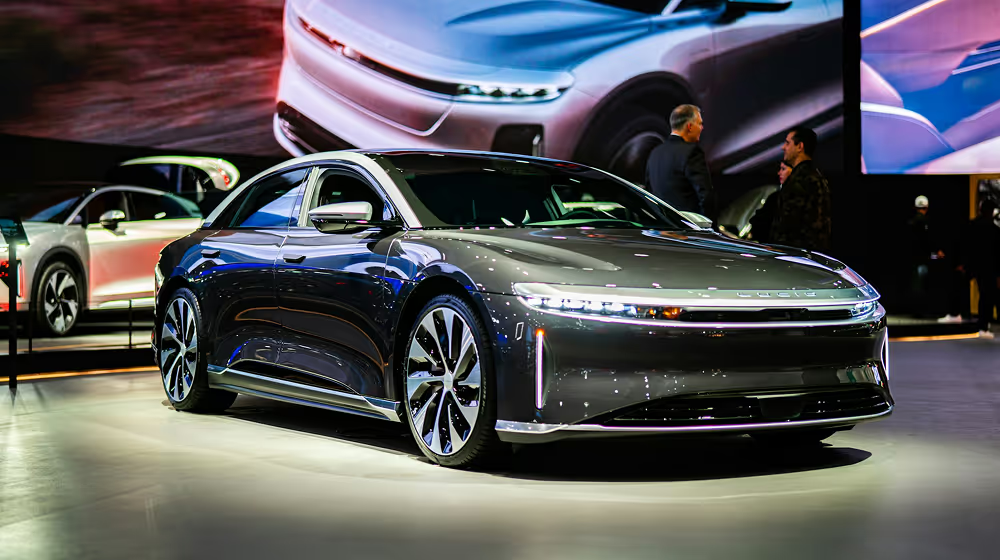
Uber’s $10 billion robotaxi bet: The ride-hail giant has committed to spending $10 billion to buy autonomous vehicles and take equity stakes in companies building AVs or autonomous technology, such as Lucid, WeRide, Rivian and Wayve. As many others have noted, this is a fundamental shift for Uber, whose business model is historically premised on the absence of depreciating assets.
Amazon’s new electric trucks: Amazon Relay, the Uber-like app that truckers use to book hauling gigs, is adding 75 electric big rigs by Swedish autonomous truck manufacturer Einride. These trucks will not be driverless, at least not immediately. Einride will continue to own and operate the trucks and will provide the charging infrastructure at five different points. This could be some very helpful buzz to Einride as it gets ready to go public via SPAC.
Tesla unveils massive spending plan: The company plans $25 billion on capital investments in 2026 as it pivots to focusing on autonomous vehicles, AI and robotics. That’s roughly triple what it spent last year.
CATL’s six-minute charge: Chinese battery maker CATL says its new sodium ion battery can go from 10% to 98% charged in six-and-a-half minutes. It can go from 10% to 35% in one minute. If true, “range anxiety” will soon be in the rearview mirror.
What we’re reading
How the MTA built its app in-house: Vital City sits down with three people who helped design the New York MTA’s widely-lauded app to find out, “what went right?” It’s a question that rarely gets to be asked in the world of public transit apps.
One way to make U.S. transit cheaper: The Urban Institute highlights the tremendous cost that “inefficient community engagement” adds to U.S. public transit projects. The solution is not to do away with public feedback, but to do it more quickly and ideally earlier in the planning process, among other things.